
Policy brief
- Home
- Policy brief
BACKGROUND
The housing market plays a critical role in the development of every economy. Its impact on job creation, economic growth, productivity and the general well-being of households has been well documented. In Ghana, the sector faces significant challenges that inhibit lowand middle-income households’ access to decent and affordable housing, especially in urban areas. With the urban population expected to constitute more than 60% of the country’s population by 2030, the challenge in providing affordable housing is likely to intensify. Despite past interventions by succeeding governments, the housing situation remains constrained by affordability gaps, regulatory bottlenecks, and an underdeveloped housing finance system. Addressing these challenges would require substantial investments and strategic interventions. The National Homeownership Fund (NHF) is well positioned to spearhead the required interventions, including overseeing the development of a sustainable housing finance system and facilitating the delivery of affordable housing by the private sector.
The resulting imbalance between demand and supply has been a subject of public discourse for more than two decades. While the quantitative housing deficit appears to have eased from 2.8 million in 2010 to 1.8 million in 2024, qualitative deficits pertaining to overcrowding, poor housing conditions and tenure insecurities persist in many urban centres. The fundamental challenge in the housing sector is the inability of many low- and middle-income households to afford even the cheapest house delivered through formal channels under existing financing arrangements. This is the result of the combination of high house prices and the lack of affordable mortgage products. Developers face difficulties in delivering houses that are affordable to low and middle-income households due to land acquisition bottlenecks, high cost of building materials and lack of trunk infrastructure. Similarly, lenders are unable to offer affordable mortgages due to limited access to cheap long-term funding. Addressing Ghana’s affordable housing conundrum will require simultaneously tackling the demand and supply constraints.
THE AFFORDABLE HOUSING SITUATION IN GHANA
Ghana’s increasing population and the high incidence of household formation remain the major drivers of housing demand, especially in urban areas. According to the Ghana Statistical Service, the urban population will increase from 56.7% in 2021 to 60.7% in 2030. In line with the expected rise in the urbanization rate, the greater share of new households will be in urban areas. This is likely to heighten existing challenges in providing affordable housing for low- and middle-income households. At the same time, housing supply, which is predominantly delivered through informal channels, has not kept pace with the increasing demand over the years.
OVERVIEW OF THE ECONOMIC AND POLICY ENVIRONMENTS FOR HOUSING IN GHANA
A stable and growing economy is pivotal to the delivery of affordable housing. Effective demand for housing is spurred by improvements in macroeconomic fundamentals such as business productivity, employment generation, income levels, inflation and interest rates, among others. Ghana’s economy has had periods of boom and bust over the past two decades. The boom periods are usually marked by high commodity prices and fiscal discipline, while excessive expenditure, particularly in election years, tends to precede the bust years.The economy has, in recent years, experienced a remarkable recovery from the sharp downturn it suffered in 2022, with a rebound in economic growth, low inflation and a stable currency. Consequently, the Ghana Reference Rate, which is the primary benchmark interest rate for pricing loans, has since the start of 2025 consistently declined, recording its lowest level of 10.02% in June 2026. This has led to a reduction in lending rates. Sustaining these improvements over an extended period will be essential in creating an enabling environment for a vibrant mortgage market. As of August, 2026, the interest rate under the Scheme with Republic Bank stood at 8.4%. This makes mortgages more affordable and accessible to the Ghanaian worker.On the policy front, Ghana has, since independence, pursued a variety of policies in the housing sector. Broadly, two main approaches to housing delivery have been adopted by succeeding governments – direct state involvement in housing delivery and the creation of an enabling environment for the private sector-led housing delivery. Since the mid-eighties, the policy of creating an enabling environment to promote greater private sector participation in housing delivery has been emphasized with the 2015 Housing Policy making it one of the key objectives. Despite this clear policy stance, there have been sporadic interventions in housing delivery by succeeding governments with so-called affordable housing projects. These projects are usually abandoned when there is a change in government and have been viewed by many as inefficient allocation of resources.
REVIEW OF NHF INTERVENTIONS IN THE HOUSING SECTOR
Since its establishment in 2018, the National Homeownership Fund, which is a state-owned housing finance company, has successfully implemented two schemes on a pilot basis – mortgage and rent-to-own schemes. In line with the objective of reducing the cost of local currency mortgage offered by banks, NHF partnered with three banks – Stanbic, Republic and GCB Bank – to deliver cedi mortgages at affordable interest rates to public sector workers. Under the scheme, NHF offers funds at a concessionary rate of 2% to be matched by the participating banks at the 91-day Treasury bill rate plus 300 basis points.
OVERVIEW OF GHANA’S MORTGAGE MARKET
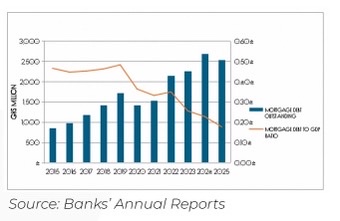
The use of mortgage loans for house purchases is a common feature in most economies. However, the situation in Ghana is very different, with only a very small share of the population using mortgages for home acquisitions. The mortgage-to-GDP ratio, which is used to measure the depth of mortgage markets, was 0.18% as at the end of 2025, falling from 0.48% in 2019. Furthermore, only 8 out of the 23 universal banks offer mortgage products in any meaningful way. Figure 1 displays the total amount of mortgage debt outstanding for the period 2015 – 2025. The total amount of mortgage debt outstanding at the end of 2025 was just about GHS 2.5 billion, decreasing from GHS 2.7 billion recorded in 2024. This is an indication of the lack of progress in developing the market and underscores the need for strategic interventions in the sector.The goal is to enable the participating banks to write local currency loans at an affordable rate for low- and middle-income households. The loans are variable and reset quarterly based on the prevailing rate on the 91-day Treasury bill. Borrowers can be offered up to 100% loan-to-value and a tenor of 20 years to purchase houses from approved developers who are required to meet specified criteria relating to pricing and housing standards approved under the Scheme. Developers under the Scheme are also offered construction loans at concessionary rates. The total loans disbursed to the participating banks at the end of 2024 were about GHS 23. 3million. About 1,000 workers have benefited from the Scheme. Under the rent-to-own scheme, housing units are rented out to lower and middle-income earners with the option to purchase the units at a future date. The first scheme, which had NHF and GCB Capital as anchor investors, was set up as a Real Estate Investment Trust (REIT) in 2019. The company, GCB REIT, partnered TDC Ghana Ltd and Adom City Estate Company Ltd to offer housing units to public sector workers on either a rent-to-own basis or rental. NHF also partnered with CAL Asset Management Company Ltd to set up another REIT in 2022, but this is yet to become operational. NHF’s investments in both entities stood at approximately GHS 20 million at the end of 2024. Over 200 workers have benefited from the Scheme. In addition to the mortgage and rent-to-own schemes, NHF has invested substantial amounts in several housing projects.
Recent interventions by the National
Homeownership Fund to provide affordable
local currency mortgages and promote
rent-to-own schemes and construction
financing demonstrate a commitment to
solving the intractable housing affordability
challenges. These schemes, especially the
mortgage scheme, have shown a lot of
promise.
There is a need to scale up such interventions to match the scale of the affordable housing challenge the country faces. While the bulk of the investments in the housing sector are expected to come from the private sector, public funding remains critical to enable the delivery of affordable housing.
STRATEGIC INTERVENTIONS TO BRIDGE GAPS IN AFFORDABLE HOUSING DELIVERY
To remove some of the key constraints on the demand and supply sides of the housing market and accelerate the delivery of affordable housing, there is an urgent need for strategic interventions by the NHF. The overarching goal of these interventions is to catalyze private capital into the housing sector through partnerships and derisking investments in the sector. The first strategic intervention the NHF can make is to spearhead the establishment of a Mortgage Refinance Company (MRC) to channel long-term funds and provide liquidity to mortgage lenders. The MRC will provide an effective mechanism to channel long-term funds, particularly private pension funds, to the housing finance sector. The resulting expansion in the supply of mortgage credit and reduction in liquidity risk will lower mortgage interest rates. The MRC should be structured as a limited liability company with shareholding by key state-owned institutions such as DBG and GIIF along with financial institutions and international development finance institutions such as the IFC and Shelter Afrique. Similar facilities have been established in Egypt, Nigeria and Tanzania with the support of the World Bank, and Ghana can follow their examples. Countries such as Morocco, Kenya, Nigeria, and Algeria are strategically using the housing sector to drive economic growth and job creation. Some of these countries have addressed their housing finance gap through levies on selected building materials. Kenya generates approximately $50 million from its housing levy per month, while Morocco makes approximately $5 million per month. Ghana can adopt a similar approach to catalyze investment in the housing sector while driving economic growth and job creation.CONCLUSION
NHF has shown great promise in addressing both demand and supply-side challenges of affordable housing delivery in Ghana. The Company, however, requires more resources to scale up its interventions to be able to benefit more Ghanaian workers.